
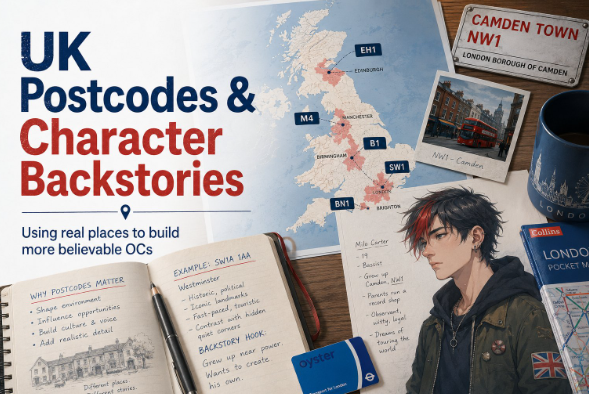
I used to treat UK postcodes as boring address details. Something you check when a parcel goes missing, or when you are trying to work out whether a town is close to Manchester, Leeds, Bristol, or somewhere completely different.
That changed when I began writing more original character profiles.
A character can have a great name, a sharp outfit, and a dramatic backstory, but if I cannot imagine where they buy lunch, how they get home, or what kind of street they walk down after dark, the whole thing feels thin. That is why I now start many character ideas with a place. Not always a full address, of course. A broad postcode area is enough.
When I build an OC, I often sketch the setting first, then use an AI OC make tool later to turn the idea into a clearer character direction. That order works better for me. Place first. Visuals after.
Why A Postcode Can Help With Character Writing
A UK postcode gives you more than a location. It gives you a small clue about the life around that location.
A London postcode does not feel the same as a postcode in Cornwall. A postcode near Glasgow does not suggest the same daily routine as one near a market town in Norfolk. Even before I look deeply into a place, I can usually start asking better questions.
Does this character live somewhere busy or quiet?
Do they need a car?
Is the train station close enough to matter?
Would they know their neighbours?
Would they complain about tourists, traffic, rent, weather, or nothing at all?
Those questions are small, but they pull a character down from the clouds.
I do not use postcode research to copy real people. That would feel lazy and, in some cases, uncomfortable. I use it to understand the shape of a place. The final character still needs their own habits, flaws, goals, and private mess.
My Simple Way Of Reading A Postcode Area
I keep the process rough. Too much research can kill the writing before it starts.
| What I Check | Why I Care |
| City, town, village, coast, or suburb | It changes the character’s daily rhythm |
| Nearby transport | It affects school, work, friendships, and escape routes |
| Local housing feel | It hints at money, pressure, family setup, and routine |
| Weather and landscape | It helps with clothing, mood, and scene details |
| Distance from bigger places | It shows whether the character feels connected or stuck |
This is not a formal research system. It is just the way I stop myself from writing another “mysterious character from nowhere.”
For example, if I choose a postcode area near a coastal town, I may think about wind, damp clothes, seasonal visitors, long winter evenings, and part-time jobs in cafés or small shops. If I choose a dense city area, the character may have a different relationship with noise, crowds, rent, buses, corner shops, and late-night streets.
The postcode does not decide the story. It gives the story some ground.
A Small Example From My Own Notes
Here is the kind of note I might write before building a character:
Lives in a quiet postcode district outside a larger city. Not fully rural, not fully urban. Bus service is unreliable after evening. Works weekends. Knows the main road too well. Wants to leave, but also feels guilty about leaving.
That is not a finished character, but it already feels more useful than:
Cool girl with dark hair and a sad past.
The first note gives me movement. It gives me weather. It gives me family pressure. It tells me why she might be tired, why she checks bus times, why she keeps money hidden in a coat pocket.
This is the part people sometimes skip. They jump straight to hair colour, eye colour, weapon, outfit, power, or aesthetic. I like those details too, but they work better when they come from somewhere.
How Place Changes The Visual Design
After I know the setting, I start thinking about appearance. A character from a rainy northern town may not dress the same way as a character from a warmer southern coastal area. Someone who walks a lot may wear practical shoes. Someone who spends time in stations may carry a worn backpack. Someone from a wealthy area may try to reject that background through messy styling, cheap jewellery, or second-hand clothes.
These little contradictions make the OC more interesting.
Sometimes I use visual tools at this stage. If I have a real image direction and want to test an anime-style version, I may use a photo to anime workflow. I do not expect the first result to solve everything. I use it more like a mood test. Does this face fit the backstory? Does the outfit look too polished? Does the character still feel like they belong to the postcode area I imagined?
A good visual draft should raise questions, not end the process.
The Mistake I Try To Avoid
The biggest mistake is stuffing too many facts into the profile.
Nobody wants to read a character bio that sounds like a local council page. I do not need to mention every road, nearby school, shopping centre, station, and county boundary. One or two strong details are better.
Bad version:
She lives in a postcode area near several transport routes, retail streets, residential roads, schools, supermarkets, and local service facilities.
Better version:
She lives ten minutes from the high street, close enough to hear buses at night, but far enough that walking home in winter feels longer than it should.
The second one feels human. It still comes from location research, but it does not sound like research.
My Quick Checklist For A Postcode-Based OC
When I feel stuck, I use this short list:
| Question | My Usual Answer Style |
| What kind of area shaped them? | Busy estate, quiet village, seaside town, outer suburb |
| What do they see every week? | Station, fields, corner shop, old flats, main road |
| What annoys them? | Rent, buses, tourists, noise, boredom, distance |
| What do they secretly like? | Familiar streets, local food, night walks, being known |
| What visual detail shows this? | Coat, bag, shoes, hair, accessory, posture |
This works because it connects outside life with inside life. A character who hates their town may still defend it when someone else insults it. A character from a quiet place may crave the city but panic when they finally get there. A character from a crowded postcode may dream about silence, then feel lonely when they find it.
That kind of tension is useful.
Why I Prefer Broad Postcode Areas Over Exact Addresses
I never use a real full address for a fictional character. It feels unnecessary and too close to someone’s private life. A broad area is enough for writing.
A postcode district or general town reference gives me useful texture without pretending the character lives in a real person’s house. It also keeps the writing flexible. I can borrow the mood of a place without being trapped by exact map accuracy.
That matters especially for fantasy, anime, game, and OC projects. The character may not live in the real UK at all, but a UK postcode can still inspire a believable environment. A foggy town. A cramped flat above shops. A long bus ride. A seaside arcade. A school near a main road. These details travel well into fiction.
Final Thoughts
A postcode looks small, but it can fix one of the weakest parts of character creation: the empty background.
When I start with place, I write better characters. Not because the postcode is magical, but because it forces me to ask ordinary questions. Where does this person go when they are tired? What road do they know too well? What weather are they dressed for? What part of home do they want to escape, and what part would they miss?
Those answers usually matter more than another dramatic scar or rare eye colour.
For me, a strong OC does not begin with a perfect design. It begins with a believable life. A postcode area is one quiet way to find it.