

What the Partnership Is & What’s New
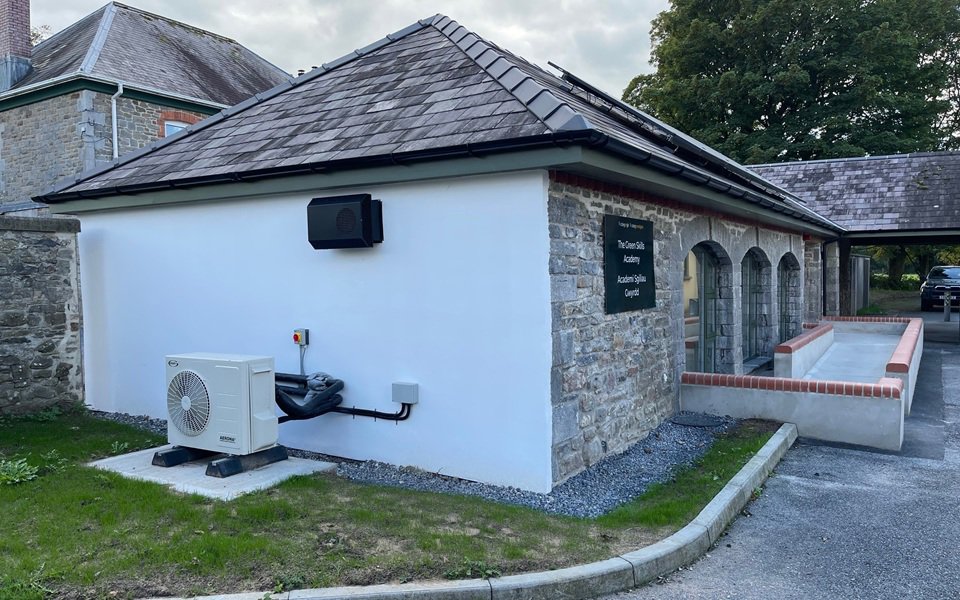
- On 26 September 2025, Coleg Sir Gâr officially opened its new Green Skills Academy at the Gelli Aur campus — a renovated 19th-century cart house turned into a modern sustainable-energy training facility. (csgcc.ac.uk)
- As part of the redevelopment, Grant UK provided and installed renewable-energy equipment: air-source heat pumps (e.g. their Aerona³ R32 6 kW system), underfloor heating, triple-glazed windows, insulation using recycled or natural materials, solar PV and thermal systems — creating a real-world “living classroom” for sustainable building retrofit and renewables training. (grantuk.com)
- The partnership means that Grant UK will deliver its full suite of air-source heat pump (ASHP) training courses at the Green Skills Academy. That includes short (1-day) installer courses for its Aerona 290 and Aerona³ systems, as well as a “System Design” course. (grantuk.com)
- For Coleg Sir Gâr, this helps significantly expand their green-skills curriculum — enabling students and trainees to gain hands-on experience with modern renewable heating technologies. The Green Skills Academy is described as equipping people for “the jobs of a low-carbon future.” (csgcc.ac.uk)
Why This Partnership Matters: Strategic Aims & Broader Context
- Addressing skills-gaps in renewables & retrofit: With rising demand for energy-efficient housing and low-carbon heating, there’s a growing need for trained installers and professionals. The Green Skills Academy + Grant UK partnership positions Coleg Sir Gâr as a hub for these “green jobs.” (csgcc.ac.uk)
- Hands-on, real-world training: Because the facility uses live systems (heat pumps, underfloor heating, solar thermal/PV, modern insulation), students are not just learning theory — they’re seeing how sustainable technologies are implemented in real buildings. That helps bridge education and practical industry needs. (grantuk.com)
- Supporting Wales’ decarbonization and retrofit goals: As governments push for Net Zero and energy efficiency, training centers like this help build a workforce capable of delivering retrofit, renewables, and energy-management work — important for both private housing and public infrastructure. (csgcc.ac.uk)
- Improved vocational education & employability pathways: For students at Coleg Sir Gâr (and trainees from elsewhere), having access to certification and training from a recognized provider like Grant UK can improve employability in high-demand green-energy trades — potentially offering stable careers.
What Stakeholders & Participants Are Saying — Comments & Reactions
- From Grant UK’s side: their Training Manager, Phil Stanley, said the transformation of the 19th-century farm building “is an excellent example of showcasing how older properties can be brought back to life in an energy-efficient way.” He added that Grant UK looks forward to continuing the partnership — using the Green Skills Academy to deliver heat pump training to installers and engineers across Wales. (grantuk.com)
- From Coleg Sir Gâr’s side: Jemma Parsons, Head of the Green Skills Academy, said the facility has “one clear vision: to equip people with the skills for the jobs of a low carbon future.” She emphasized that the Academy is more than just a renovation — it’s a “living classroom,” designed to teach renewables, retrofit, energy management, and carbon-reduction skills. (csgcc.ac.uk)
- Broader support: The development is part of a larger push to equip Wales’s workforce for sustainability, retrofit, and renewables — reflecting growing demand from employers, public-sector bodies, and social-housing organisations for trained staff in these areas. (GOV.WALES)
Some Early Results & Institutional Impact (Case-Style Evidence)
- As of 2023–2024, Coleg Sir Gâr’s Green Skills offering had already delivered nearly 1,400 qualifications across areas such as environmental sustainability, retrofit, renewables, energy assessment, and traditional building repair/maintenance. (csgcc.ac.uk)
- The Green Skills Academy renovation was supported by public funding (through the UK Shared Prosperity Fund — SPF) and aims to serve both college students and external trainees, including heating installers and professionals seeking to reskill. (csgcc.ac.uk)
- The new ASHP-training courses from Grant UK now make Coleg Sir Gâr one of the few institutions in Wales where students can get formal training on modern, low-carbon heating technologies with real equipment — a step toward closing the skills gap in the green-jobs sector.
What to Watch / What’s Not Yet Clear
- The funding for the renovation and ongoing operations currently relies on public funding (SPF, PLA, grants) — future sustainability will depend on continued funding or commercial demand for green-jobs training. (csgcc.ac.uk)
- While the facility is designed to support a broad audience (students, professional installers, employers), the actual uptake — especially among working professionals who may find it hard to take “time out” for training — remains to be seen. Historically, such challenges have been noted by the college in similar programmes. (GOV.WALES)
- The integration of new green-skills courses and apprenticeships (e.g. a new energy-management apprenticeship planned from August 2025) will need sufficient demand and employer buy-in to make the pathway viable long-term. (csgcc.ac.uk)
What This Partnership Suggests for the Future — Broader Implications
- The Grant UK / Coleg Sir Gâr collaboration demonstrates a concrete model for how educational institutions and industry providers can align to prepare a workforce for the green-economy transition: combining academic education, vocational training, and real-world systems.
- It positions retrofit, renewable heating, and energy-management skills as central to the future of construction, housing, and environmental resilience — suggesting such partnerships may be increasingly common as countries push for decarbonization.
- For prospective students or professionals interested in “green jobs,” this opens a pathway that is formal, accredited, and practical — beneficial for employability and sustainable development goals.
- Finally, it shows how heritage properties (like a 19th-century cart house) can be repurposed for modern training needs, linking preservation with sustainability and skills development.
- Here’s a deeper dive — with case-studies and comments — on the recent extension of the strategic partnership between Grant UK Training Academy (Grant UK) and Coleg Sir Gâr — what’s working, what’s been achieved so far, and what different stakeholders say.


What the partnership is — and how it’s implemented (real-life “case study”)
- In September 2025, Coleg Sir Gâr officially opened a new facility — the Green Skills Academy — at its Gelli Aur campus. Part of that campus is a restored 19th-century cart house, converted into a modern, energy-efficient building equipped for training in renewables and retrofit. (csgcc.ac.uk)
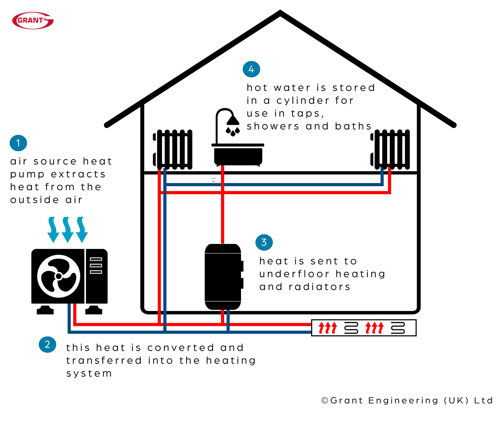
- As part of the renovation, Grant UK provided and installed renewable-energy and heating infrastructure: underfloor heating with a 6 kW air-source heat pump (their Aerona³ R32), insulation (limecrete floor, recycled foam glass, natural wool insulation), triple-glazed windows, solar PV and thermal systems, modern ventilation, and smart energy controls. (grantuk.com)
- The building now serves as a “living classroom”: it houses lecture rooms and a “practical training room” where Grant’s products are installed — letting students learn in a real, functioning building, not just theory. (grantuk.com)
- Through the partnership, Grant UK Training Academy now delivers its full suite of air-source heat pump (ASHP) training courses at the Green Skills Academy — including 1-day installer courses for Aerona 290 and Aerona³, and a 1-day system design course. (grantuk.com)
Thus, this is a concrete, tangible collaboration: a historically significant building converted into a high-quality training centre — combining sustainability, heritage retrofit, and skills development.
Early Results & Broader “Case Study” Impacts
The partnership — and the Green Skills Academy more broadly — are already showing measurable impact in several dimensions:
- According to internal reports from Coleg Sir Gâr: between 2023 and 2024, through Personal Learning Account (PLA) funding, the Green Skills Academy helped deliver nearly 1,400 qualifications covering areas such as environmental sustainability (IEMA), retrofit, energy assessment, renewables, traditional building maintenance, drone pilot licensing, green infrastructure, and more. (csgcc.ac.uk)
- The Academy reports that in 2024/2025 it engaged 764 learners via PLA funding plus 400 via shared-prosperity funding, showing growing enrolment and demand. (csgcc.ac.uk)
- The college is also launching a new apprenticeship in energy management starting August 2025 — one of the first of its kind in Wales — which reflects how the collaboration is translating into more formal, long-term career pathways. (csgcc.ac.uk)
- The Green Skills Academy claims ISEP (Institute of Sustainability and Environmental Professionals) Centre status — giving its certificates and training a globally recognised standard. (csgcc.ac.uk)
All these show that the partnership isn’t just symbolic: it’s producing trained professionals, helping plug skills gaps, and offering real routes into green-jobs sector (retrofit, renewables, energy management) — which aligns with wider policy goals around decarbonisation and sustainability.
What Stakeholders Are Saying — Comments & Perspectives
From publicly available statements about the partnership and the Green Skills Academy:
- From Grant UK’s side: their Training Manager, Phil Stanley, said the transformation of the 19th-century farm building into a modern, energy-efficient training environment “is an excellent example of showing how older properties can be brought back to life in an energy-efficient way.” He added that Grant UK looks forward to continuing the partnership — using the Academy to deliver their heat-pump training courses to installers and engineers in Wales. (grantuk.com)
- From Coleg Sir Gâr’s side: the Academy’s head, Jemma Parsons, said the Green Skills Academy has “one clear vision: to equip people with the skills for the jobs of a low-carbon future.” She emphasised that the Academy is more than just a renovation — it’s a “living classroom,” designed to teach renewables, retrofit, energy management, and carbon-reduction skills. (csgcc.ac.uk)
- The college board’s recent minutes (April 2025) note with approval that the Academy is fulfilling strategic priorities: green education, workforce development, innovation, and preparing for Net Zero — acknowledging there is a “growing skills gap” especially in renewables/retrofit, and that the Academy is targeting that need. (csgcc.ac.uk)
- External support: The partnership aligns with broader governmental and sector priorities: Welsh policy aims to boost “green construction, retrofit and energy-efficiency skills” to support climate goals. (GOV.WALES)
These voices reflect confidence that the partnership is meaningful — combining heritage building retrofit, modern sustainable heating systems, and professional/specialist training — all under a shared goal of delivering a skilled green workforce.
Challenges & What to Monitor — Limitations, Risks & What’s Not Yet Certain
Even with these successes, there are some caveats or open questions:
- The funding at present relies heavily on public sources: PLA funding, shared-prosperity funds, etc. According to board minutes, while PLA funding will continue, the college is seeking to secure commercial funding or employer-sponsored funding to ensure long-term sustainability beyond public grants. (csgcc.ac.uk)
- Historically, institutions offering retrofit/renewables training have reported difficulty recruiting some tradespeople or employers, especially because “time out” for training can be a barrier for working professionals or small contractors. That challenge has been acknowledged in similar contexts. (GOV.WALES)
- There’s a question of supply and demand balance: while the Academy can train many people, actual employer uptake depends on demand for retrofit/renewable work in the region and whether qualified students get job opportunities. If demand is lower than expected, the risk is that training doesn’t convert into sustained employment.
- Because the Academy also works with retrofitting historic buildings, scaling up may face structural/heritage-regulation constraints — what works in a renovated cart house may be harder to replicate at scale across different building types or housing stock.
Significance & Broader Implications — What This Partnership Contributes
- This partnership is a concrete model for how education institutions + industry providers can collaborate to address green-skills gaps — particularly in heating, retrofit, renewables, and energy-efficiency sectors. This is exactly the kind of workforce development needed for the transition to low-carbon building and living.
- It shows how heritage buildings can be repurposed for modern use: classical or historic buildings (like a 19th-century cart house) can be retrofitted to high energy-efficiency standards — serving as “living classrooms” and demonstration models. That helps bridge heritage preservation and sustainability.
- It strengthens the pathways into green careers: for students, for installers, for professionals — offering recognized training, practical experience with live systems, and potential accreditation (ISEP or industry-standard credentials).
- On a regional/national level (in Wales), it contributes to decarbonization strategies, energy-efficiency goals, and the creation of a skilled workforce needed for large-scale retrofit programmes, social housing upgrades, renewable heating installations, and sustainable infrastructure.